
Letting my Inner Granny Out

Sometimes it feels like Tokyo has more fashionable areas than you can shake a stick at (side note: where does that idiom even come from??). The most well-known, at least from an international perspective, is likely Harajuku, the "kawaii capital" of Japan.

But did you know that there is, in fact, a "second Harajuku" in Tokyo?


Several stops north of Ikebukuro on the Yamanote Line is Sugamo, an area colloquially known as the "Harajuku for grannies." Sugamo is a shopping district where everything moves at a slower pace. The main street is lined with stores, many of them specializing in things that, well, old people would need or want: specialty Japanese ingredients, visors, canes, and special red underwear. (I'll come back to that in a moment.)

One really interesting thing I noticed walking up the street was how accessible each of the shops was. All of them were wheelchair and walker-friendly: there were no steps and the aisles were wide and free of obstructions. The boulevard, too, was wide and easily designed for easy meandering.


Along with my friend Frances (who initially proposed this excursion) I stopped to get one of the region's specialty foods, shiodaifuku, a slightly salty rice cake filled with red bean paste (in this case unsweetened). Sounds weird, tastes delicious.


Another thing Sugamo is known for is Koganji Temple. Koganji Temple is a Buddhist temple famous for its Togenuki Jizo statue, which is said to have healing powers. People line up to pour water and wash, with a cloth, the Jizo statue and then press the cloth to their injury or affliction which will then, presumably, be magically healed!


Now, back to the red underwear.

At the far end of the shopping street is a bright red store: red awning, red signs, and red products of all varieties. This is Maruji, a shop whose products are all designed to promote good luck and prosperity. Red underwear, in particular, is supposed to ward off disease and promote good health and energy in general. The storefront is eye-catching, if nothing else!


From Sugamo, Frances and I walked even further north to the Kyu-Furukawa Gardens.

To our pleasant surprise, there was a large English-style manor built on the grounds. The building was designed by English architect Josiah Condor who apparently designed multiple public buildings in Tokyo during the Meiji Period (1868-1912). 

We weren't allowed to go into the house (we missed the daily predetermined tour times) but the guide who took us on a tour of the expansive Japanese garden told us that the first floor rooms were all designed in Western-style but the second floor, where the Furukawa family would have actually lived, was built in traditional Japanese style with tatami mats and shoji screen doors. So the first floor was for "showing off" how enlightened and wealthy you were, while the second floor was for comfortable living. You really can't tell that's the case from the exterior, however, which I think is a fascinating dichotomy. 


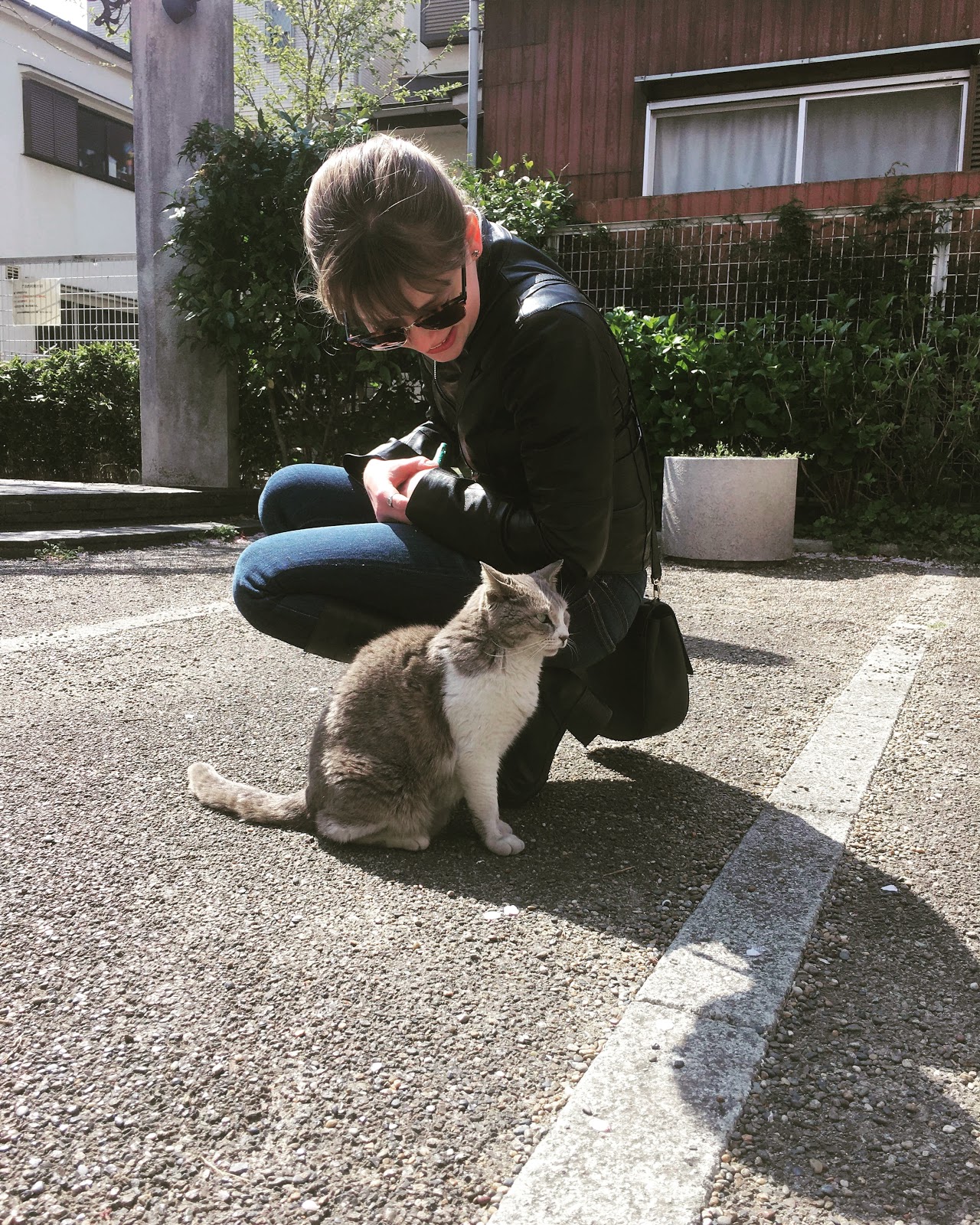
Also, I made a cat friend while walking around the backstreets of the neighborhood!

Comments

Popular posts from this blog

Enoshima: The Heavenly Maiden and the Dragon

This past Monday was a national holiday -- Mountain Day -- so, of course, Troy and I headed to the beach instead. Well, to an island near a beach since (as some of you may know) I'm not exactly the beach-going type. Plus I'd just climbed Mount Fuji, which was more than enough mountain for me. Enoshima is a small island off the coast of Kanagawa Prefecture, fairly near Kamakura. It's connected to the mainland via a bridge, so you can just stroll on over from the train station. The entire island is dedicated to Benzaitan, the goddess of everything that flows -- time, water, speech, music, and knowledge. According to the "Enoshima Engi," (a history of the shrines and temples on Enoshima) there's also a legend associated with the creation of the island involving Benzaitan and a dragon. In brief, the area around Enoshima was once wracked by violent storms and earthquakes. Eventually the tumult ended and a heavenly maiden (Benzaitan) descended from the clouds....

Fukuoka: A Saga of Shrines

As many long-term residents of Japan do, I have a goal to visit all 47 prefectures of Japan. Just last week, together with my parents, who flew over from Chicago for a long weekend, I checked off No. 25: Fukuoka Prefecture. I'd never been to Fukuoka, which is on Japan's southerly island of Kyushu, before, but everyone I know who had visited had told me it was a great trip. It's capital, also called Fukuoka, has the distinction of being both Japan's youngest city and also the city with the fastest growing population, making it one of the only metropolitan areas outside of Tokyo with an increasing number of residents. A very dynamic place to visit; a vibrant city with an old, old history. WARNING: LOOOONG POST AHEAD. Friday morning my parents and I hop over on a flight from Haneda Airport to Fukuoka Airport, which is a fantastic 10 minutes away form the city center. Ten. Minutes. What I would do to have one of Tokyo's airports be that close! The weather was sunn...

文化祭!(Bunkasai--Cultural Festival Days 1 and 2) and Man I'm Tired!

So this weekend was Musashino Joshi's annual Cultural Festival, an event that all high schools (I would assume) have, where the school is open to the public and classes and clubs put on events, or set up quiz games or food booths. Essentially it's like a carnival. Traditional culture...not so much (though there are aspects of it). Mostly it's just good fun. My class was doing a chocolate banana food booth, so on Friday (the school-wide prep day, even though techincally it was another Japanese holiday) we got cardboard and began making our booth, which was Hawaiian themed. And you'd think it wouldn't take very long, but it took the entire day and then about half an hour on Saturday. (Also, what' you're seeing is Summer Uniform Form 1.5, where there's the sweater over the shirt.) But in the end the booth turned out pretty sweet, if I may say so myself: The top says Chocobana, and the sides of the poles are made to look like palm trees with a monkay on it...